Showing posts with label mobile application development. Show all posts

How Long Does It Take to Develop a Custom Mobile Application?

Custom Mobile Application  Development

Developing a mobile application can be a complex and lengthy process. Depending on the complexity of the application, it can take anywhere from several weeks to several months to develop a mobile app. The time frame for developing a custom app depends on factors such as the scope of the project, the number of features required, and any integrations that need to be made. It also depends on whether you are using an existing framework or building an entirely new solution from scratch. With careful planning and efficient development processes, it is possible to reduce the time taken for mobile app development.

custom app development


Developing a mobile application is no small feat. It requires a lot of planning, coding, testing, and debugging before it is ready to be released into the market. Depending on the complexity of the project, it can take anywhere from a few weeks to several months for a mobile app to be developed.

A custom app developer can be even more time-consuming as it involves designing an app according to specific requirements. The process also involves creating user stories and wireframes, developing features and functions, and testing for bugs and usability issues before finally launching the app in the market.

Developing a mobile application can be a daunting task, but understanding the process and timeline involved can help you plan accordingly. The time it takes to develop a mobile application depends on the complexity of the project and the number of features you want to include in your app.

Custom app development requires careful planning and research to ensure that all requirements are met. From designing user interfaces to coding, testing, and deploying, there is a lot that goes into developing an app. To get an estimate of how long it will take to develop your mobile application, consider factors such as the platform you’re developing for, the scope of work, and any additional design or coding requirements.

Custom Software Solutions Enhance Your Business

Custom software development

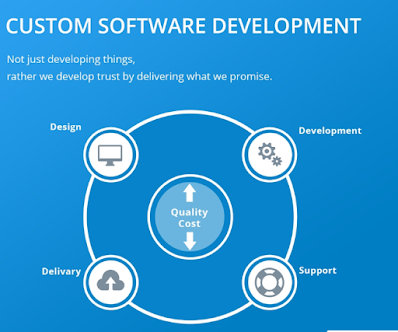
Custom software development is the process of designing, creating, deploying, maintaining, and developing support software for a specific set of users, functions, or Business organizations. Custom software designed for a specific set of tasks, Such as a field service equipment maintenance program for a specific Business

Custom Software is cheaper and faster than buying off-the-shelf software and more flexible than building your own software. A custom software development company has a team of engineers and can develop and deliver your application in a short span of time.


custom software development

Custom software development is the design, creation, and implementation of software that is unique to the needs of a specific client or company. Custom software development is not limited to just large businesses - it can be used for small or medium-sized businesses as well.

Custom software development has many benefits over buying off-the-shelf solutions. For starters, it can meet any requirements that are not fulfilled by an existing solution. This could be because the product doesn't exist in the market or because it doesn't have all of the features you need if you have a niche requirement for example. The other benefit is customization - often clients already have an idea of what they want their solution to do but need someone to create it for them, custom software developers are perfect for this kind of work as they are able.

Software development is the process of designing, creating, and maintaining software projects.

Software development may be undertaken by an individual or a team, typically with extensive knowledge in computer programming.

Some of the most popular types of software projects include applications (e.g., word processors), system software (e.g., operating systems), and programming libraries (e.g., graphics libraries).

Custom Software Development is a process that often requires expertise in multiple different fields to create software that meets the needs of its buyers.

The custom software development process includes two major stages: requirements analysis and design.

Requirements analysis consists of understanding what the customer wants from their new application or system, then defining what it should do at a high level before proceeding to more detailed design decisions. The Design is then focused on completing the actual

The custom software development process is the process of developing a software application programming interface, or API. The API is built to suit the needs of the developers. It can be an application programming interface for a third-party service or it might be used by another application that is being developed.

There are many benefits of using an API to create software applications that are not only faster to develop, but also have fewer coding errors. One of the most important benefits is that APIs use standardized protocols so coding can be done independently by different programmers and in different languages.

Benefits of Custom Software Development

Custom software development is the process of creating a software product that is tailored to meet the specific needs of a particular company. Custom software development can also be applied to products that are not traditionally thought of as software, but which involve programming.

There are many benefits of custom software development, including:

-Increased productivity -Improved quality -Reduced risk -Lower cost


PLANNING AND ANALYSIS

A winning client software project is one that delivers an answer to objectives on time. That needs good planning designing from the beginning of the thought life of the project. Work along with your custom package developer and keep centered on your key objectives. This will make sure that you receive a custom software solution that meets your business wants and provides you with an honest comeback on your investment.

BETTER SECURITY
Often when you invest in custom software development, you’re investing in better security for your custom software. Since you control the software, you can dictate how secure it needs to be, and know that the right security decisions have been made

INTEGRATE BUSINESS SYSTEMS INTO ONE APP 
Custom software development can help you integrate business systems into one app. This helps increase efficiency and exclude the time spent trying to use off-the-shelf software products that don’t fit the needs of your business. Using existing software often means you have to adapt your business software processes, but custom software development products align with your unique business processes and goals. 

TECHNICAL SUPPORT
Custom software products provide a technical support team that understands the design and the development process of the product. custom software developers can help with any issues or updates that you have with your software moving forward.


Aezion provides a full range of Custom Software Development Services in Dallas, Texas to assist Clients with solutions to their most important business and operational challenges.


The Best Mobile Application Development Tools

 Mobile application development tools are a set of software and hardware used in the process of developing mobile applications.

Mobile Application Development


Mobile app development tools can be divided into two categories: cross-platform and native. Cross-platform mobile app development tools are those that allow developers to create apps for multiple platforms without having to learn the languages or use the SDKs for each platform. Native mobile app development tools, on the other hand, are those that require developers to learn the language and SDKs for each platform they want their apps to be compatible with.

The best mobile application development tool is one that has a wide range of features, is easy to use, has a low cost of ownership, and is compatible with multiple platforms.

Mobile application development tools are used to develop mobile applications for Android, iOS, and other platforms.

Some of the best app development tools for mobile include PhoneGap, Xamarin, and React Native. They are mainly used to build cross-platform apps.

The best mobile application development statistics tools are essential for the success of your business. The market is saturated with many different tools and a few of them are really good. Here are some of the most popular ones that you should consider using:

Android Studio, PhoneGap Build, Appcelerator Titanium, AppMakr, React Native

The best mobile application development tools are essential for the success of your business. The market is saturated with many different tools and a few of them are really good. Here are some of the most popular ones that you should consider using: Android Studio, PhoneGap Build, Appcelerator Titanium, AppMakr, React Native.

Contact Us Today!

Aezion Mobile Application Development in Dallas includes IOS, Android, Xamarin, React Native, and Hybrid Apps Development.


Features of Telemedicine Application Development

Features of Telemedicine Application  

Telemedicine apps are becoming more and more popular in the healthcare industry. They are used for many purposes, one of them is to provide remote healthcare services to people who need them.

Telemedicine Application Development


The features of telemedicine apps depend on the type of app that is being developed. For example, if an app is designed for remote patient monitoring, then it will have features like video streaming and data transfer. If it's for remote diagnosis, then there will be features like chat application and voice call. 

A telemedicine application is a mobile application that is used to provide medical care remotely. This type of app can be used by doctors and patients alike.

Some of the features include:

- A messaging system for the patient and doctor to communicate with each other

- A virtual consultation room where the doctor can talk to the patient, examine them, diagnose them, and prescribe treatment

- A medication management system where the doctor can prescribe medications for their patients

Telemedicine applications are mobile applications that enable medical consultations and healthcare services to be delivered remotely.

The features of telemedicine application development include:

The use of video conferencing, live streaming, and other communication methods to provide a safe and secure environment for the patient.

 Creating a system that is easy to use by both the patient and the doctor.

 Ensuring that all data is secure and private.

Telemedicine applications are now being developed for many different purposes, including providing medical care for patients in remote locations.

The telemedicine application development process includes the following steps:

1. Identifying the need or opportunity for a telemedicine application

2. Conducting an analysis of the current state of affairs, identifying potential users and beneficiaries

3. Developing a business case to show how the benefits outweigh the costs

4. Developing a prototype, which can be tested with users and stakeholders to identify any gaps in the design or functionality

5. Developing specifications (i.e., requirements) for an application, including hardware and software requirements

6. Developing a detailed plan for developing and testing the application.

and visit

Top 10 Mobile app development Management Tools

Top 10 Mobile app development Frameworks 

The mobile app development has been one of the hottest topics in technology for quite some time now. There are many apps that are being developed by companies with all kinds of varied purposes. These include gaming, gaming, entertainment, productivity, research, and more.

The increasing demand for different types of apps has led to an increase in the number of app developers. The problem is that it is difficult to find the best mobile app development, management tools to help them create all these apps.

Mobile applications are software that is created to run on devices such as smartphones, tablets, or watches to perform various tasks. there are types various mobile applications such as email applications, gaming, application health applications, travel applications, banking applications, etc. These applications can be easily downloaded in applications distributed platforms such as the Apple app store or Google Play store.
custom mobile apps development Frameworks


Mobile Applications are of three types that are
 Native Applications 
 Web-Based Applications 
 Hybrid Applications 

Native Applications

Native applications are designed to run on a particular platform such as Android, Windows, IOS. The main objective is to design, creating these applications make sure the best performance. Created best and class modules. As a result, this application provides a very good user interface, performance, and consistency. 

Web-Based Applications


Web-based applications require internet connectivity and written HTML, CSS, Javascript.

Hybrid Applications

As the name suggests hybrid applications are a combination of both native and web-based applications.

The top 10 Mobile Application Framework Tools 


1. React Native: React Native is an open-source framework, It's developed, maintained by Facebook. React native is helpful to develop, maintain Android and IOS apps seamlessly. React Native apps are best because of faster development and deployment. 

2. Flutter

Flutter is a Google open-source framework for developing Native Android and IOS apps using single code bases. It is using a highly reliable mobile UI framework for creating striking apps quickly by speeding up the development process.

3. Xamarin

Xamarin is a Microsoft open source-based framework, it allows you to build native applications for Android, IOS, and windows forms. Xamarin benefits are using the huge community of around 1.4 million developers, native API access & reliable UI support, easier API Integration, cost-effective & Faster development process.

4. Ionic

Ionic is a widely used free open source project development framework. It is a client-side framework that helps in native apps. Using a blend of  HTML5, CSS3, and Javascript.

5. Apache Cordova:

The Apache Cordova framework allows developers to implement applications on multiple platforms. It is developed by Nitobi, adobe systems in 2011 and later it releases open source. Apache Cordova enables software programmers to develop hybrid web applications for Mobile devices. Using HTML5, CSS3, and Javascript, controlled by on platform-specific API like those in Android, IOS, or windows phone.

6. Corona

Corona is ten times speeder then compare to other mobile app development frameworks. Its ease of use, speed, and flexibility to develop apps.

7. JQuery Mobile 

Jquery Mobile is an HTML5 based framework. It can run throughout all the devices with just a similar code version.

8 Native Script

Native Script creates applications that are completely native using Javascript or Typescript this is used to build Android and IOS applications  

9. Appcelerator Titanium

Makes use of Angular and Boostrap to build HTML5 hybrid mobile applications
Features
Code reusability
seamless integration 
Drag and drop palette
Bi-directional updates
Combines and normalizes the data

10 MobileAngular UI

Mobile Angular UI Makes use of Angular and Boostrap to build HTML5 hybrid mobile applications
Features
Excellent Documentation
Embedded with Boostrap
Make Use of Angular directives 

Aezion provides Custom Mobile Application Development in Dallas includes IOS, Android, Xamarin, React Native, and Hybrid Apps Development.


9 Essential Features of Successful Mobile Applications

Features of Successful Mobile Applications


With almost 4 million mobile apps available for download on Google Play alone, it can be difficult to see how you can develop a business mobile app that will stand out. However, as adults spend an average of nearly 4 hours a day using them, mobile apps are not something that a modern business can ignore.

A mobile application is a software application designed to run on smartphones, tablets, or other mobile devices. Mobile apps are usually developed in one of the programming languages like HTML5, Swift, or Java. They can be downloaded from app stores or accessed through links that are provided by the developer.

Mobile applications are different from normal applications as they have to be able to operate independently without relying on installation on a desktop computer. Moreover, they have to be compatible with multiple platforms and form factors.

There are many aspects of a mobile app that will determine its success. But, if you get the core principles right, it will go a long way towards making your app an app that people want to use. Here are the key features that any mobile app will need if it is to be a success.

1. Successful Mobile Apps Satisfy a Need

Any type of product needs to satisfy a need. When you are designing a business mobile app, you should not simply copy what your competitors are doing. You should think outside the box and think big. A successful mobile app is one that solves a problem for its users better than any other solution. It is an application that makes a user’s life simpler. 

2. Simplicity

While people are spending more and more time on mobile apps, the amount of time they are willing to spend on any one app is very limited. For that reason, an app must be easy to access and easy to use. Content and functionality need to be available with a minimum of user interaction. A key design feature of a good mobile app is effortless simplicity.

3. Customization

Allow the users of your mobile app to customize the app the way they want it. That can be as simple as giving them control over the fonts and the colors. Or, it could be allowing users to save their own favorites. Customization gives the user a sense of ownership. Once they have the app the way that they like it, they will be less willing to switch to using a competitor’s app.

4. Performance

Speed is of the essence with mobile apps. Mobile app users are often multi-tasking. So, if an app takes too long to load or to perform a function, users will switch off and do something else instead. Performance testing will be part of the development cycle for a mobile app. However, ongoing performance testing will also be needed to ensure that changes to the app do not cause any performance issues.

5. Develop for Android and iOS

It is important to develop mobile apps for both Android and iOS. These are the two most popular platforms. This can be achieved by developing the app in a cross-platform development framework, like Xamarin. Cross-platform development tools reduce the total cost of development and make your app available to a wider audience.

6. Social Integration

Social media integration is a must for most types of mobile apps. For simplicity, you can allow users to sign in with Twitter or Facebook. Users love to share their experiences too. So, allow users to share posts or purchases easily. It improves the user experience, and it can be a valuable form of marketing.

7. Feedback

Make it easy for users to leave feedback. It creates a sense of involvement and it shows that your business listens to its customers. It should be simple for a user to leave reviews and comments. You should also encourage comments about the functionality of the app. It will help you to improve your services and it will help with the future direction of the app.

8. Security

Recent well-publicized online breaches of confidentiality have made app security even more important. It is a fundamental requirement of any mobile app that users’ private data remains confidential. It is also important that the users know that robust security is in place. So, make sure that the app’s confidentiality statement is easy to locate.

9. Offline Functionality

It is natural that most apps will require an internet connection to work fully. However, there should be some features that will work off-line as well. If an app can offer even limited functionality offline, it could represent a major advantage.

Upgrades and Support
A business mobile app will need ongoing development and support. That will be both in terms of fixing bugs, and in terms of ongoing software enhancements. An app needs to be kept fresh and relevant. If a mobile app stagnates, users may become bored and switch to a more modern app.
Features of Successful Mobile Applications

The way that people access the internet is changing. Mobile device access to the internet has already surpassed desktop access. Today, businesses, large and small, need to develop mobile apps if they are going to stay ahead of their competitors. Developing an app for the sake of an app, though, will be counterproductive. Mobile apps of the future will need to connect with and engage customers. They will need to be easy to use, relevant, and they will need to fulfill a need.
When you’re ready to consider a mobile app for your business, choose a development partner like  Aezion Inc. The platformmobile application development experience.


Choosing the Right Frontend Framework in 2026: What Engineering Leaders Need to Know

In the last three years alone,  front-end  frameworks have improved more than they did in the entire  previous  decade. Faster compilation t...